Insurance Claim Roofing Contractor in Marietta, GA
An insurance claim roofing contractor is a licensed roofer who inspects your roof after storm damage, documents what the storm did, meets your insurance adjuster on-site, and then prices and performs the repair or replacement against the carrier's scope of loss. In Marietta, that work happens under Cobb County permitting with a Georgia Licensed Roofing Contractor.
If you are searching for an insurance claim roofing contractor in Marietta, GA, the short answer is this: hire a roofer who is licensed in Georgia, who documents damage before you file, and who will stand on the roof with your adjuster. Patton Construction is a Georgia Licensed Roofing Contractor serving Marietta, Kennesaw and greater Cobb County. We inspect the roof after hail or wind, photograph every elevation and the soft metals, meet the carrier's adjuster on-site, and review the scope of work before a single shingle comes off. Coverage decisions and payouts are made by your carrier, not by us. Call (470) 422-7898 to start with a damage inspection.
Key Takeaways
- An insurance claim roofing contractor documents storm damage and supports your claim; the carrier still decides what it pays.
- Georgia licensing matters on claim work because code-compliant installation and permit records back up the scope of loss.
- Having your roofer present at the adjuster's on-site inspection is one of the highest-value steps in a Marietta roof claim.
- Insurance covers sudden storm damage, not gradual wear, so the documented cause of the damage drives the outcome.
- Patton Construction works with Marietta and Cobb County homeowners on inspection, documentation, adjuster meetings, and the repair itself.
What does an insurance claim roofing contractor do that a general roofer does not?
In the first sentence: a claim-focused contractor documents storm damage to the standard an adjuster works from, and stays in the claim until the scope is settled.
Any competent roofer can install shingles. Claim work adds a documentation and process layer on top of the installation. That layer is what this page is about.
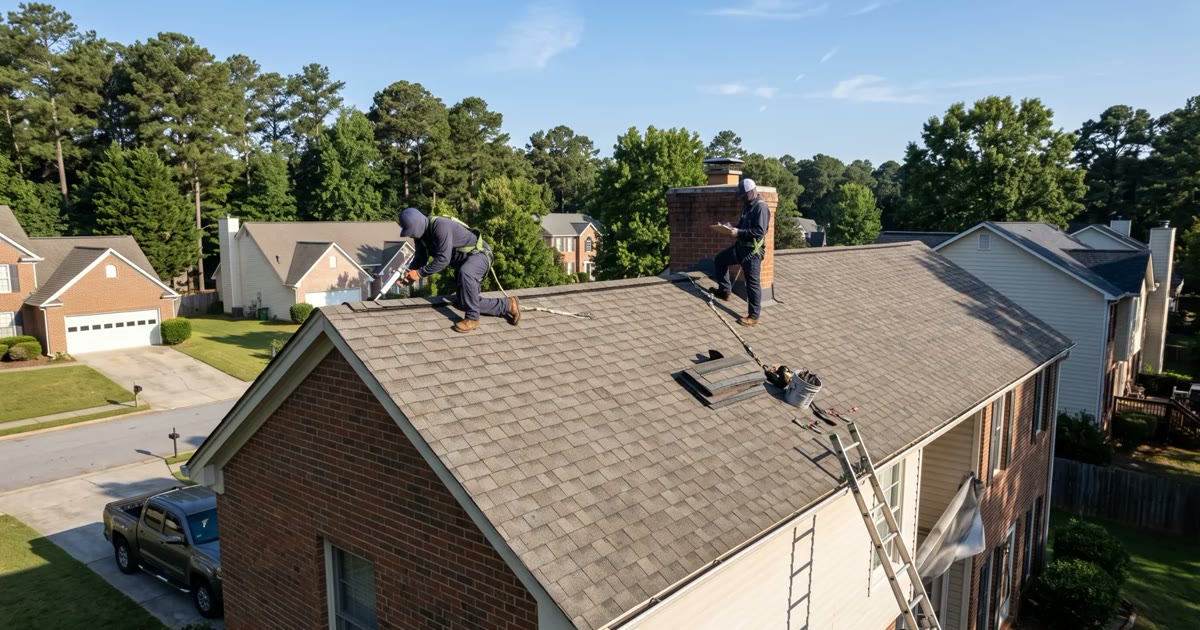
It comes down to four concrete things. First, a full inspection with photos of every roof elevation, plus gutters, vents and flashing, because hail strikes on soft metals often read more clearly than strikes on shingle fields. Second, a written damage summary you can reference when you talk to your carrier. Third, attendance at the adjuster's on-site inspection, where the damage can be pointed out directly rather than inferred from a photograph later. Fourth, a review of the adjuster's scope and estimate so the repair is priced against what the roof actually needs.
What we do not do is promise an outcome. The carrier decides what it pays for. Our role is to make sure the evidence in front of them is complete and correctly presented.
Insurance claim roofing contractor compared with the alternatives
Marietta homeowners usually weigh three paths after storm damage. The table below sets out what each one actually covers.
| What you need | Licensed roofing contractor with claim experience | General roofer without claim experience | Public adjuster |
|---|---|---|---|
| Roof inspection and damage photos | Yes — every elevation plus soft metals | Often limited to visible shingles from the ground | Yes, as part of the claim file |
| Written documentation for your carrier | Yes — damage summary and scope notes | Usually not prepared | Yes — that is their core service |
| Attends the adjuster's on-site inspection | Yes | Rarely | Yes |
| Performs the repair or replacement | Yes | Yes | No — they do not build roofs |
| Pulls Cobb County permits and builds to code | Yes | Varies by operator | No |
| Decides what the carrier pays | No — the carrier decides | No — the carrier decides | No — the carrier decides |
| Typically paid by | You, for the roof work | You, for the roof work | A percentage of the claim settlement |
If your situation is a disputed or denied claim rather than a straightforward storm loss, a public adjuster represents you against the carrier and a roofing contractor does not. Many homeowners use both. What matters is knowing which role each one plays before you sign anything.
How does the claim process run from inspection to finished roof?
The sequence runs: inspection, documentation, filing, adjuster meeting, scope review, repair. Skipping a step is what creates most disputes.
- Inspection. A contractor walks the roof, photographs damage, and checks interior ceilings and attic spaces for water entry.
- Documentation. Photos, measurements and notes are assembled into a damage summary that names the storm event and the affected roof components.
- Filing. You notify your carrier. The policyholder owns the claim, so this step is yours.
- Adjuster meeting. The carrier sends an adjuster. Your contractor can be present to walk the roof and point out damage.
- Scope review. The adjuster's estimate is compared against the contractor's estimate. Missing line items, code requirements and hidden damage can be submitted as a supplement.
- Repair or replacement. Work is performed, permits closed, and any recoverable depreciation released per your policy terms.
Why does Georgia licensing matter on an insurance claim roof?
Because the license is what makes the installation and the paperwork stand up when the carrier looks at the scope.
Patton Construction is a Georgia Licensed Roofing Contractor, and that license carries competency and accountability requirements that an unlicensed operator does not answer to. On claim work specifically, a licensed contractor knows how scopes of loss are structured and how to document supplemental damage found during tear-off while the roof is still open. The license also means permits are pulled and the build follows current code, which matters because carriers often owe code-upgrade items on covered replacements. An installer who ignores code hands that argument away.
Which parts of a Marietta roof do adjusters look at first?
Adjusters start with the components most likely to show storm evidence, and those are not always the shingle field.
Hail damage across Cobb County typically shows up as bruised mats and loosened tabs across the roof field, which is easy to miss from the driveway. Soft metals — gutters, downspouts, vents, valleys and flashing — usually carry the clearest strike marks, so those get photographed first. Ridge caps, pipe boots and any prior repair areas come next, because carriers look closely at whether damage is new or pre-existing. Interior evidence matters too: ceiling stains, attic decking marks and insulation moisture tie an exterior finding to an actual water path.
What should you have ready before the adjuster arrives?
Have your policy documents, the date of the storm, and your contractor's photo record ready, and clear access to the roof and attic.
Three things speed up an adjuster visit. First, your policy declarations, so coverage limits, your deductible and any roof-age provisions can be referenced on the spot. Second, the date and nature of the storm event, since carriers match claims to named or recorded weather. Third, your contractor's damage photos, which let the adjuster verify findings rather than start from zero. Practically, also make sure the attic is accessible and that vehicles are moved away from the roofline so ladders can be set safely.
Frequently Asked Questions
Do I need a roofing contractor before I file a claim in Marietta?
You are not required to have one, but an inspection before filing tells you whether the damage is likely to exceed your deductible. That single fact prevents claims that go nowhere and leave a claim history entry with no payout behind it. Coverage decisions and payouts are made by your carrier.
Can a roofing contractor negotiate my insurance claim for me?
A contractor can meet your adjuster on-site, supply documentation and discuss the technical scope of the damage. The policyholder owns the claim and the final decisions. Negotiating a settlement on your behalf is the role of a public adjuster or an attorney, not a roofing contractor.
Will filing a roof claim raise my insurance premium in Georgia?
A single weather-related claim may affect your renewal rate, but carriers price weather events regionally, and a widespread Cobb County hailstorm affects many homes at once. Rate decisions belong to your carrier and depend on your insurer and claim history. Your agent can explain how a weather claim is treated under your policy before you file.
How long do I have to file a roof damage claim in Georgia?
Most policies require prompt notice of damage, and Georgia law sets a limit on how long you have to file suit against an insurer after a claim dispute. The exact windows live in your policy documents and vary by carrier. Confirm your specific deadlines with your carrier or agent.
What if the adjuster's estimate is lower than my contractor's bid?
Discrepancies between an adjuster's scope and a contractor's estimate are common and resolvable. Your contractor can submit a supplement documenting missed line items, code requirements or hidden damage, and can request a re-inspection where warranted. Carriers adjust scopes when the documentation supports it.
Disclosure: Patton Construction is a Georgia Licensed Roofing Contractor, not an insurance company, insurance agent, or public adjuster. We do not sell insurance, adjust claims on behalf of insurers, or negotiate policy terms. Coverage decisions, claim approvals, and payouts are made solely by your insurance carrier. Information on this page is general in nature and is not insurance, legal, or financial advice; confirm the terms of your specific policy with your carrier or a licensed insurance professional.
If your Marietta or Kennesaw home took storm damage and you want a contractor who documents the roof before your adjuster arrives, call (470) 422-7898 or request an inspection through the form below.